
Consistency when motivation drops.
Signing up for an Ironman is easy. Month four, dark outside and a deadline at work, is not. More motivation does not help there. An accountability structure does.
Mental performance coaching for endurance athletes: triathlon, ultra running, marathon, road and gravel cycling.
You have the plan, the data and the hours in your legs. And still the race does not go the way the numbers say it should. Pacing falls apart in the first hour, your head opens negotiations about quitting, and somewhere around month three the sessions start to slip. That is not a physiology problem. That is where I come in.
Book a free 30-minute intro callThis is the formula behind performance coaching as Sir John Whitmore built it.
is everything your training has built: aerobic base, strength, economy, fuelling. You measure it, test it and plan it with your coach.
is everything that holds that potential back on race day or mid-season: fear of blowing up, the voice at kilometre 30, pressure to hit a time, a routine that collapses when work gets busy.
Coaching does not add kilometres. It removes what is in the way, so the athlete you have already built is the one who shows up on the start line.
Signing up for an Ironman is easy. Month four, dark outside and a deadline at work, is not. More motivation does not help there. An accountability structure does.
Why a well-written race plan falls apart in the first hour, and how to hold it when adrenaline says otherwise.
What to do with the negotiation in your head when your body says enough. Self-talk, attention control, breaking the race into sections you can actually finish.
When the result becomes part of your identity and fear of a bad time leaks into training.
How to take the lesson from it, not the doubt.
Most age-group endurance athletes train around a full-time job. Training is not separate from the rest of life, so coaching does not separate it either.
Your coach or testing lab covers physiology: thresholds, zones, periodisation, load. I do not duplicate that and I do not second-guess it.
I work where the data stops. If your answer to "How do you feel?" is whatever your watch says, that is where we start.
For coaches and performance centres: if you see athletes held back by their head rather than their engine, let's talk about working together. You run the training, I cover the mental side, and the athlete gets both without overlap.
Get in touch30 minutes, no commitment. We talk about your season, your goals and where you get stuck.
In the first session we set what you want to achieve and what is getting in the way today, using the GROW model: goal, reality, options, way forward.
60 minutes, online or in person in Ljubljana. The rhythm follows your race calendar: more often in the build, around your key race, and after it.
Specific tasks built into the training you already do. Not extra hours. A different focus in the hours you already have.
Coaching alongside your training in the build towards the start of the racing season. We build the habits, consistency and mindset you will need once the season begins.
A focused programme ahead of the race that matters most to you this season. Race plan, pacing, dark moments, pressure. You arrive at the start line with a head as prepared as your legs.
I am not a psychologist and I do not provide therapy. Performance coaching works on what stands between you and your performance today, not on your personal history. That boundary is part of the ICF code of ethics. If it becomes clear you need a different kind of support, I will tell you and point you to the right person.
I do not write training plans either. That is your coach's job.
I'm Tomaž Oštir, a performance coach and an endurance athlete.
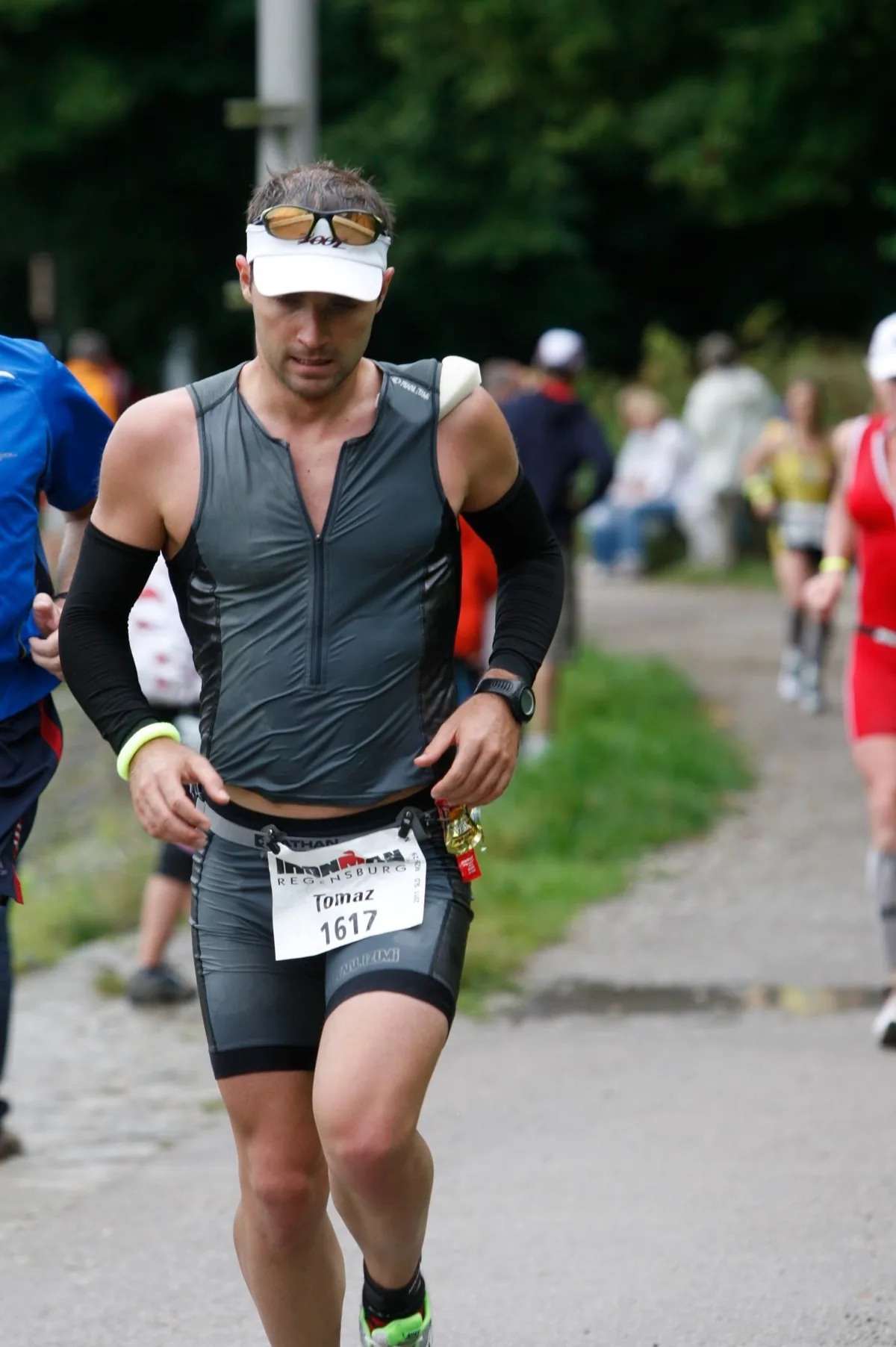
I have finished three Ironman races (Regensburg 2011 and 2012, Klagenfurt 2014). My marathon PR is 3:04, I run ultras and ride road and gravel. This year I pulled out of UTVV after 110 kilometres. I know the dark moments of a race from the inside, not from a book.
I trained as a coach in London with Performance Consultants International, the firm founded by Sir John Whitmore, who shaped performance coaching as we know it. I am a Silver Performance Coach, ICF ACC and EMCC EIA, and a board member of ICF Slovenia. I spent seventeen years leading in corporate roles, so I know what it takes to train around a full calendar.
The method builds on the work of Whitmore and Timothy Gallwey, whose Inner Game started on the tennis court.
Mental performance coaching is structured work on what holds an athlete back from performing: training consistency, pacing and decisions on race day, self-talk in the hard moments, and pressure to hit a result. At SparkMind it is led by Tomaž Oštir using the Performance Consultants International method founded by Sir John Whitmore: Performance = Potential − Interference. It is built for triathletes, ultra runners, marathon runners, and road and gravel cyclists.
A sport psychologist holds a psychology qualification and can also treat clinical issues such as anxiety. Performance coaching does not work with diagnoses or personal history. It works on goals, execution and habits today. Tomaž Oštir is not a psychologist. If a conversation shows that an athlete needs therapeutic support, he refers them on. That boundary is part of the ICF code of ethics.
Your coach is responsible for physiology: zones, thresholds, load and periodisation. A mental coach works on why the plan holds in training and falls apart on race day. Tomaž does not write training plans or interfere with your coach's work, so you get both without overlap.
In long races interference shows up at predictable moments: going out too fast, the crisis in the second half, and the negotiation about quitting. Coaching works on three things: a race plan you can hold under adrenaline, tools for the dark moments (self-talk, attention control, breaking the race into sections), and preparing for the scenarios where things go wrong. Tomaž has finished three Ironman races and runs ultras, so he knows those moments first-hand.
Yes. Most athletes Tomaž works with are age-groupers training around a job and a family. For them, interference usually shows up as consistency: month four of the build, a deadline at work, a sick child. The programme does not add training hours. It changes the focus of the hours you already have.
It starts with a free 30-minute intro call. Then you choose one of two programmes of 12 sessions each: Pre-season, which runs alongside your training before the racing season starts, or Key race, a focused build towards the race that matters most to you. Sessions last 60 minutes and the rhythm follows your race calendar. The work follows the GROW model: goal, reality, options, way forward.
The Pre-season programme fits best in the base or build phase, when there is time to build habits. Start the Key race programme early enough to fit 12 sessions before race day. You can also start after a race that did not go to plan, or after a DNF.
Both. In person in Ljubljana, Slovenia, and online by video call anywhere. Sessions are in English or Slovenian, so the programme is open to athletes outside Slovenia.
Tomaž Oštir, a performance coach and endurance athlete based in Ljubljana. He has finished three Ironman races (Regensburg 2011 and 2012, Klagenfurt 2014), has a 3:04 marathon PR, runs ultras and rides road and gravel. He is a Silver Performance Coach (Performance Consultants International), ICF ACC, EMCC EIA and a board member of ICF Slovenia.
Yes. Coaches and testing labs cover physiology, Tomaž covers the mental side, with no duplication. If you see athletes held back by their head rather than their engine, write to info@sparkmind.eu.
Book a free 30-minute intro call at sparkmind.eu/en/athletes. Tell Tomaž which race you are aiming for and where you get stuck. Together you work out whether coaching can help. If it can't, he will tell you.
Tell me which race you are aiming for and where you get stuck. On a free 30-minute intro call we will work out whether coaching can help. If it can't, I'll tell you that too.